The short answer
OT networks control physical processes, while traditional IT networks primarily manage information. Both require cybersecurity, but the consequences and operating constraints are different. An office workstation outage is disruptive. An unplanned change to a PLC, SCADA server, building control system, or process network can stop production, damage equipment, affect product quality, or create a safety issue.
That is why industrial cybersecurity must account for safety, reliability, real-time performance, vendor support, equipment lifecycle, and controlled maintenance windows. The correct approach is not weaker security. It is security engineered around the process being protected.
OT and IT protect different priorities
Traditional IT security often emphasizes confidentiality, integrity, and availability. All three matter in OT, but industrial environments frequently place immediate emphasis on safe operation, process integrity, and availability.
Security controls must not introduce unsafe process behaviour or prevent required operator action.
Systems may need to operate continuously for years with tightly controlled maintenance windows.
Latency, timing, and deterministic communications can directly affect the physical process.
NIST defines OT as programmable systems and devices that interact with the physical environment or manage devices that do. Its current final OT security guide, NIST SP 800-82 Revision 3, specifically emphasizes the unique performance, reliability, and safety requirements of these systems.
Key differences between OT networks and IT networks
| Area | Traditional IT | Operational technology |
|---|---|---|
| Primary outcome | Protect business information and user services. | Maintain safe and reliable physical operations. |
| Asset lifecycle | Commonly refreshed every few years. | Controllers and industrial systems may remain in service for decades. |
| Change windows | Regular patching and maintenance are expected. | Changes may require a shutdown, vendor approval, testing, and operational coordination. |
| Failure impact | Lost productivity, unavailable applications, or exposed data. | Production loss, equipment damage, environmental impact, or safety consequences. |
| Traffic | Highly variable user and application traffic. | Often predictable communication between known devices and systems. |
| Ownership | Usually led by IT. | Shared among operations, engineering, maintenance, vendors, and IT. |
These differences affect every security decision. A vulnerability scanner that is routine on an office network may need careful testing before it touches fragile industrial devices. A patch that closes a known vulnerability may still be unacceptable until compatibility and process impact have been assessed.
Common industrial cybersecurity mistakes
Treating the plant as one flat network
A flat network allows unnecessary communication between devices and makes incidents harder to contain. Segmentation should separate business IT, industrial operations, safety-related systems, vendor access, and other trust zones according to operational requirements.
Connecting remote access directly to control assets
Vendor and employee remote access should be deliberately designed, authenticated, logged, time-limited where appropriate, and routed through controlled access points. Convenience should not create an unmanaged path to PLCs, HMIs, or SCADA servers.
Patching without an OT change process
Unpatched systems create risk, but uncontrolled patching can also create risk. Industrial patch management needs asset knowledge, vendor guidance, backups, testing, rollback planning, and coordination with operations.
Securing assets nobody has inventoried
Many facilities do not have a reliable record of every controller, switch, workstation, protocol, connection, and software version. Without a current inventory and network diagram, teams cannot assess exposure or plan improvements responsibly.
A practical OT network security architecture
A secure industrial network does not require every device to be modern or internet-connected. It requires clear boundaries, controlled communication, and enough visibility to understand abnormal behaviour.
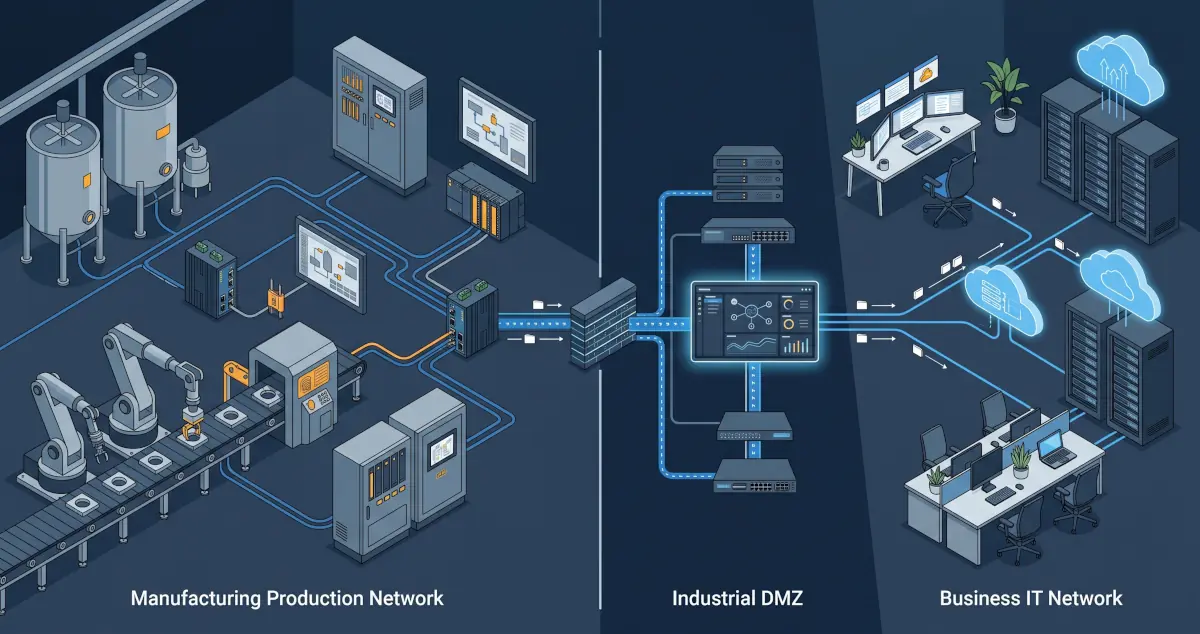
- Separate IT and OT. Route required communications through firewalls and explicitly defined rules instead of allowing broad connectivity.
- Create zones based on function and risk. Group assets according to the process, criticality, and communication they genuinely require.
- Use an industrial DMZ where appropriate. Place shared services, data transfer points, and remote-access components between business and control networks.
- Control and monitor remote access. Require strong authentication, individual accounts, logging, and a defined approval process.
- Prefer passive visibility first. Understand normal industrial communications before introducing active scanning or automated response.
- Prepare for recovery. Back up controller logic, device configurations, SCADA applications, licences, documentation, and the knowledge required to restore them.
Architecture must match the facility. A small manufacturer, water system, distributed utility, and large process plant will not need identical controls. A risk-based design is more useful than copying a generic reference diagram.
How to improve OT cybersecurity without disrupting production
- Establish joint ownership among operations, engineering, maintenance, IT, and leadership.
- Build and validate the asset inventory and current network diagram.
- Identify critical processes, required communications, and unacceptable failure modes.
- Review every connection between OT, business IT, vendors, and the internet.
- Prioritize segmentation, remote-access control, backups, monitoring, and incident response.
- Test changes in a controlled environment or approved maintenance window.
- Document recovery procedures and run tabletop exercises with the people who operate the process.
Industrial cybersecurity is an engineering and operations problem as much as it is an IT problem. The best program improves security while respecting how the facility actually runs.
Rugged Technology Services helps New Brunswick organizations assess, segment, document, and support industrial environments through our SCADA and industrial IT services.
Primary sources
- NIST SP 800-82 Revision 3, Guide to Operational Technology Security
- NIST overview of the OT security guide
OT environments are site-specific. Security changes should be reviewed by technically qualified personnel with knowledge of the affected process and safety requirements.

About the author
JR
JR works across systems integration, operational technology, embedded systems, Linux administration, and networking at Rugged Technology Services.
Read JR's profile